
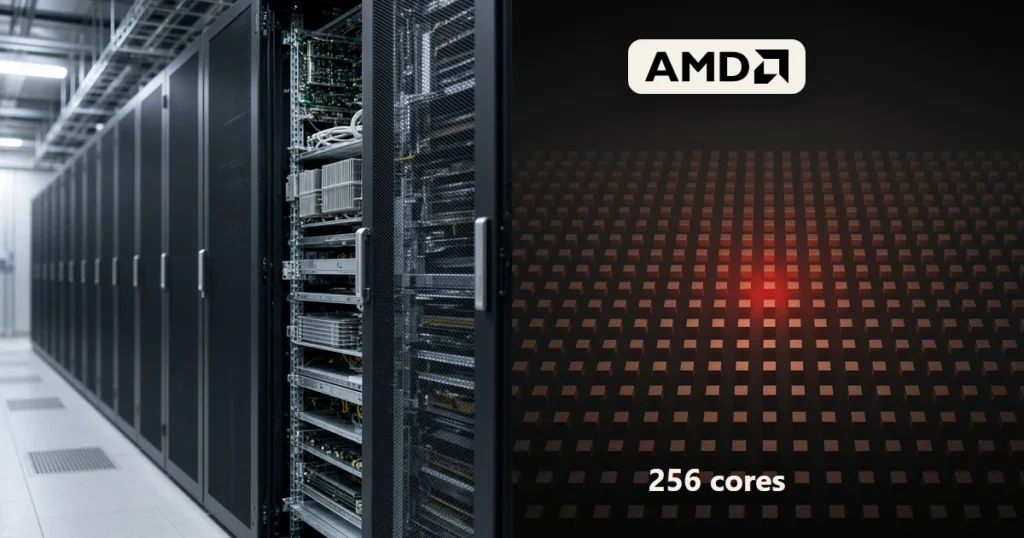
On 10 November 2026 AMD made the 6th Gen EPYC SP7 server processors generally available. They use the Zen 6 architecture. The flagship on AMD’s product page, the EPYC 9996, has 256 cores and 512 threads. Server makers are shipping systems now. Azure and Oracle Cloud instances are still described as on the way.
AMD launches powerful Zen 6 server chips. The 256-core number is the top published part, not a count for every chip in the family. Prices below are AMD’s 1,000-unit list prices in US dollars. Figures are as of 11 November 2026. Bdeb Technology has not tested a system.
AMD launches powerful Zen 6 server chips
The account is AMD’s 10 November newsroom post. The chip specifications are on the EPYC 9996 product page. AMD says the processors are for agentic AI, enterprise applications, cloud computing, high-performance computing, and general-purpose work. Dan McNamara, AMD’s senior vice president for Compute and Enterprise AI, says customers can stay on x86 and pick a part matched to the job.
The 256-core flagship
| EPYC 9996 | AMD’s published figure |
|---|---|
| Cores / threads | 256 / 512 |
| Base clock / max boost | 2.55 GHz / up to 4.1 GHz |
| L3 cache | 1024 MB |
| Default CPU power | 600 W, with a stated range of 400 W to 600 W |
| 1,000-unit price | $14,904 |
| Platform | SP7, one or two sockets |
| PCIe | PCIe 6.0, 96 lanes |
| Memory | 16 channels. DDR5 RDIMM up to 8000 MT/s, or MRDIMM up to 12800 MT/s |
| Memory bandwidth per socket | 1024 GB/s on RDIMM, or 1638 GB/s on MRDIMM |
| Product ID | 100-000001041 |
A two-socket server using two of these chips is what AMD scores as 512 cores. That is two processors, not one chip with 512 cores. AMD also describes other 6th Gen parts, including high-frequency host processors with a boost of up to 5.3 GHz. That boost is not the 4.1 GHz figure on the 9996. Starting with this generation, AMD uses “Default CPU Power” instead of TDP for the processor’s stated power.
The comparisons AMD published
AMD calls the 9996 the world’s best general-purpose processor, and the 6th Gen line the world’s best server CPU portfolio. Footnote 1 dates that portfolio judgment to 23 July 2026 and says “best” means AMD’s view of the overall mix, not first place on every test. The performance numbers below are from footnote 2, a two-socket SPECrate 2017 integer base comparison. AMD says the published scores were taken from spec.org as of 5 November 2026. The Nvidia Vera score is AMD’s own estimate, not a published SPEC result.
| Two-socket system | Cores in the system | Power | 1,000-unit price | SPECrate 2017_int_base |
|---|---|---|---|---|
| EPYC 9996 | 512 | 600 W | $14,904 | 5470, published |
| EPYC 9965, previous generation | 384 | 500 W | $11,988 | 3260, published |
| Intel Xeon 6980P | 256 | 500 W | $13,955 | 2510, published |
| Nvidia Vera | 176 | 450 W | Not published | 1459, AMD estimate |
On those figures, 5470 is about 2.2 times 2510, which is the “up to 2.2x” performance claim against the Xeon 6980P. AMD’s score per dollar for the 9996 is 0.367, against 0.180 for the 6980P, which is the “2.0x the performance per dollar” line. The 3.7x claim against Vera uses AMD’s estimate of 1459. AMD says that estimate draws on Phoronix testing and can change. Vera’s price is not published, so AMD does not give a performance-per-dollar figure for it.
The agent figures are estimates too. AMD says high-density parts can offer about 3.3 times the agents per CPU watt of Nvidia Vera and about 2.5 times the Xeon 6980P. Footnote 4 says those agent counts are thread counts used as a stand-in, not a measured agent workload. The 1.18x agents-per-rack line is also an estimate: in a 35 kW rack, AMD’s default power plan fits 16 servers, and a setting that lowers combined processor and memory power by 15 percent is what produces the 1.18x figure. The high-frequency host claim, up to 1.8x the LLM output of the previous EPYC generation, is an AMD lab measurement on PCIe 5 that AMD then projected onto PCIe 6. It is not a published third-party score.
Racks, clouds, and the embedded parts
AMD also describes Helion racks for agentic AI, in liquid-cooled, air-cooled, and air-cooled inference layouts. The company says some configurations reach 73,728 threads in one rack. Helion was introduced in October 2026, according to AMD’s own caption. Customers choose how much CPU and GPU capacity to put in the rack.
On availability, AMD says systems are shipping from leading server vendors. Meta is a lead customer and is validating platforms before a large deployment. Microsoft Azure HDv2 is in preview for AI data processing, agentic AI, and high-performance computing. Azure HXv2 is named for electronic design and technical computing, and Azure ND MI455X v7, based on AMD Helios, for production-scale inference. Oracle Cloud Infrastructure Compute E7 instances will use these processors. The opening of the same post still says the Azure and OCI instances are coming soon.
The same day, AMD announced a separate embedded line, the EPYC Embedded 9006, also up to 256 cores. That is not the server launch in the headline. AMD says the 128-core embedded part starts shipping on 15 November 2026, and the other embedded parts by the end of the year. The server processors are the ones it says are shipping now.
These are data-center CPUs for the machines that host models and agents. Choosing the tool that runs on top of that hardware is a different decision, covered in how to choose an AI coding tool and in the Grok for coding notes. API prices for one of the models people call from those servers are in DeepSeek API pricing.
Sources
- AMD newsroom, 6th Gen EPYC, 10 November 2026. Availability, Zen 6, the 9996 claims, Helion, Azure, OCI, Meta, and footnotes 1 to 5.
- AMD, EPYC 9996 product page, checked 11 November 2026. Cores, clocks, cache, power, price, PCIe, and memory.
- SPEC CPU 2017. AMD cites result cpu2017-20261020-52013 for the 5470 score. The exact result address in AMD’s footnote returned 404 on 11 November 2026.
- AMD, EPYC Embedded 9006, 10 November 2026. The separate embedded line, its 256-core ceiling, and the 15 November ship date for the 128-core part.
AMD launches powerful Zen 6 server chips
On 10 November 2026 AMD made 6th Gen EPYC SP7 server processors generally available, using the Zen 6 architecture. The EPYC 9996 has 256 cores and 512 threads, a 2.55 GHz base clock, a boost of up to 4.1 GHz, and a 1,000-unit list price of $14,904. Server systems are shipping. Azure and Oracle Cloud instances are still described as coming, with Azure HDv2 already in preview.
How does the EPYC 9996 compare with Intel and Nvidia?
On AMD’s two-socket SPECrate 2017 integer comparison, the 9996 scores 5470, the Xeon 6980P scores 2510, and Nvidia Vera is an AMD estimate of 1459 rather than a published SPEC result. AMD puts the 9996 at about 2.2 times the 6980P score and about 2.0 times the performance per dollar. The 3.7 times claim against Vera uses that estimate.
Are the 256-core embedded processors the same launch?
No. AMD announced EPYC Embedded 9006 the same day, also up to 256 cores. The 128-core embedded part is scheduled from 15 November 2026, and the other embedded parts by the end of the year. The server processors are the ones AMD says are shipping from server vendors now.